Search This Blog

Sunday, August 21, 2011

San Francisco Street Food Festival

I love street food, real street food, the kind that speaks to the hands of someone who made a few items, things they make in the style of their family, the imperfect world of food prepared for service on the run. There is something about the immediacy of food prepared and served for eating on the move, the lack of refinement and the nature of the cook’s hands making the food from shelf to mouth. It is the purest, and probably the oldest form of food cooked for others.
This past Saturday was the 3rd Annual San Francisco Street Food Festival presented by La Cocina, this event occurs in the Mission District of San Francisco and is a great food scene with many of the City’s buzz-worthy restaurants and trucks taking part and supporting La Cocina.  I love the Mission District of San Francisco, although it has it’s seedy side, areas where you are probably best off not being too familiar with, it is also one of the most vital and diverse neighborhoods in a very diverse city. With its traditionally Hispanic population and lower socioeconomic incomes blending with the newer influx of hispters and foodies, the neighborhood buzzes with activity every day. There are precious few places where you can go from a block of three dollar burritos to perfect croissants and pizzas by walking a block or two. In this mix is La Cocina, an incubator kitchen focused on assisting lower income and underserved women with starting food businesses, providing them a place to cook, a source for ingredients and advice and direction in dealing with the codes and requirements of starting a business. This is their way of celebrating the support, food-centric people and neighborhood that has supported their efforts.
Although there were some very polished restaurants at this festival, showing all the glory of cooking in a brigade, all the culinary training, the great sourcing and quality of their ingredients and polish of theior technique, there is still something wonderfully uncontrolled about vending a limited menu, out the front of a truck or tent, that makes this food special. Because this is The Mission, there was also the guy with a tiny hot dog cart, the tinkling of the Mexican ice cream push cart and even the odd entrepreneur selling home baked cookies. What a mix it was.
We got to experience Salvadoran, Asian, American and fusions of all of these in various guises. My eating companions included food journalists and taste makers from around the U.S., as I had the opportunity to eat and visit with the media covering this event. It was interesting to hear their take on the San Francisco food and food scene. There is something very enjoyable about eating and drinking with folks that take this part of our local culture seriously.
Some random images as well.
Even when you live out of a shopping cart, a friend or two sure makes the day go better.
I love these luchadore masks with the great colors
Is there something that speaks to California and Mexican street food than grilled corn?

Who needs hundreds of dollars of portable fryers and steamers when you have a dog cart.
We got two dishes from this cook, the puffy masa cakes with cheese folded into the cake and some corn cakes that would make any brunch better, here she cooks just for us (not so much really)
There were cocktails, as there needed to be, Lynchburg Lemonade
And later, we found a small but sleek coffee shop, with the hot tattooed baristas, and open seats
Lime pangas, this seemed such a great decoration for a food booth in the Mission
Mmmm, fried chicken, and I did not know there were such things as portable fryolators, I feel I will have to get one of these.
This was also very cook, a kushiyaki grill with traditional Japanese charcoal, I got some grilled beef heart off of this little grill.
And looking over all of the festivities, one of the many murals around the Mission District

There was quite the crowd, featuring all of the diversity that San Francisco is so well known for. I was forunate to meet up with my friend Mai from Flavor Boulevard, who had ventured over to experience the event as well. Here is her take on the festival. It was certainly fortuitous that she found me, as Mai is tiny, I would never have found her amongst the crowds. I tend to stand out a bit more.

Where are all the usual close-up food pics and detailed culinary descriptions? Well, for me, this event is really more about people, people and community and a shared passion for the locale. I was glad to be there supporting a good cause and a fine neighborhood, the food was just a part of a great day.

Sunday, August 14, 2011

Home-made Alkali Noodles

Following up on my ramen post, I decided to make some alkali noodles to complement the level of flavor development that I had with the smoked brisket and bacon broth I used for the last ramen post. The noodles, which I bought, were just not good enough, they were soft coming out of the bag and got softer after a bried cooking. I think ramen needs to have noodles with texture and tooth, because of the hot broth, the alkali noodle is a perfect foil for the broth.

I am basing this on a variety of sources, but, took a large amount on inspiration from Lucky Peach, the aforementioned quarterly from the mind of David Chang. Since I based it upon his recipe, I hesitate to publish the recipe, as you should really buy this publication. However, the real key is simple, you need some form of kansui, an alkaline powder, which lends additional body to the noodle.

I went with a batch using 3 cups of flour and just enough water and kansui to pull a rough dough together. This was then kneaded for 5 minutes, an athletic 5 minutes, to pull together the dough into a not quite smooth dough.
Wrapped in plastic wrap and allowed to rest for 20 to 30 minutes, this results in the time for a second kneading, to further develop gluten, I suppose.
After this, since I was not going to need the noodles today, I split the recipe in two, wrapped the dough balls in plastic wrap and placed in the refrigerator. It needs to be in there for an hour at least, so my plan is to chill them for at least an hour, then I will freeze one ball and keep the other one for tomorrow night.
One day later, I rolled and cut the ramen by hand, this was not by choice. I would sure like to know where the heck my pasta rollers have gotten to. How could they get lost? Oh well, ramen rustica I guess. After rolling, I hand cut and floured the noodles.
These were later boiled in hot water while everyhting else was prepared. Since I did not want to do a lot of cooking tonight, I went with a simple 'tare' of Tonkatsu sauce. I happen to like Tonkatsu sauce and it works great to support the flavors in ramen.
Tonight was leftovers, so I at the last of my brisket dashi, fortified with some chicken legs and some furikake I had lying around. A couple of eggs, shreds of chicken and some green beans from last night. Ta Daaaa! Quick(ish) ramen dinner.

Thursday, August 11, 2011

Peach Pie

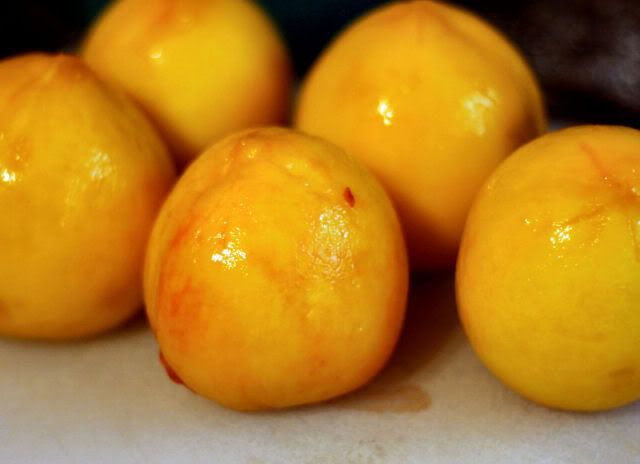
I was fortunate enough to receive a bunch of peaches from my friend Chris, who has adopted a peach tree, along with many of her friends, from the Masumoto Family Farm just south of Fresno. They have a progran where you can adopt one of their peach trees. This is a great program and the Masumoto's have an organic peach product that you will be hard pressed to find in a market near you. Harvesting the heirloom variety 'Elberta' peach, you get a soft ripe peach ready to eat as soon as it hits your hand. I got five of them and decided it was time to make a pie.

Here are the five very large peaches, peeled by using a quick blanch, no more than 20 seconds in hot water, then a plunge into ice water and immediate peeling. The skin just slips off. These were sectioned into slices and seasoned with 3 teaspoons of turninado sugar, a spalsh of cognac, 1/2 teaspoon each of fresh ground nutmeg and fresh ground cinnamon and a little mace and 1/4 teaspoon of salt. You need that small amount of salt. I also add 1 teaspoon or so of cornstarch to add some thickening to the peach juices.
A pie crust was made, using my families heirloom pie crust recipe. No kidding, it is an heirloom pie crust recipe. During World War 2, my uncles Roy's father was interned, like many Japanese, but, unlike many of his fellow Japanese, he had run a restaurant prior to the war. The chef assigned to the kitchen in the concentration camp Roy's father was assigned to was the pastry chef from the Waldorf-Astoria Hotel. He had no idea how to cook with war rations and cook for large numbers of people in a cafeteria setting. My uncles father was 'hired' to assist, in exchange, he learned pastry. After the war, Roy's father returned to Fresno and made great pies, running a lunch and pie counter for years. It was a marvel to watch him in his old age making pie crusts by feel, choosing how much lard, shortening or butter, and how much water, to add based on the feel of the flour. I killed all of his bonsai, but, I will keep that pie crust recipe alive!
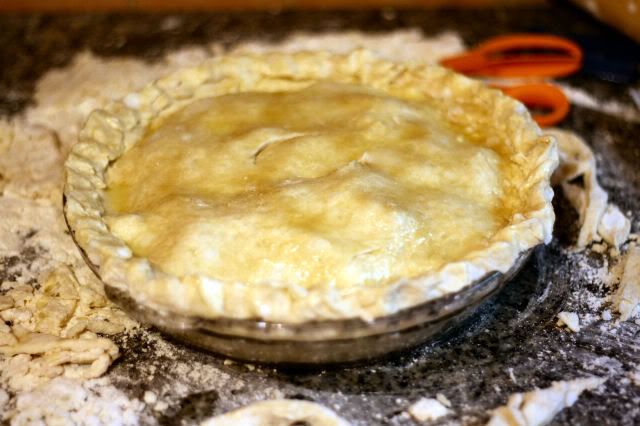
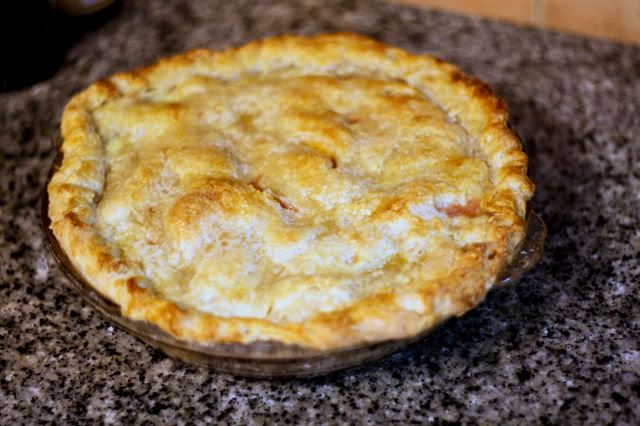
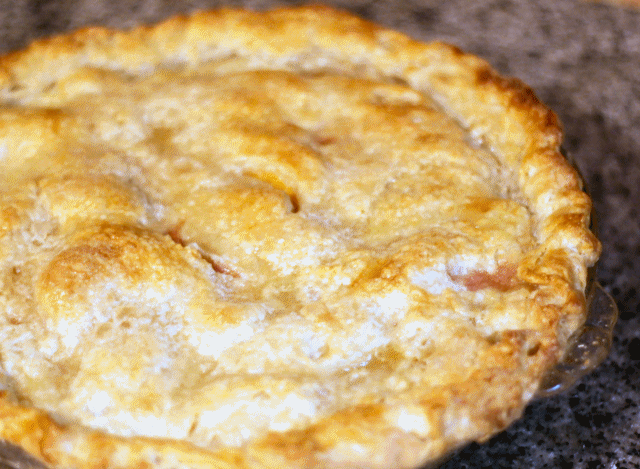
The crust was brushed with an egg wash, purely ornamental. Then into a 385F oven for 40 minutes or until browned. It may have taken a little longer. This photo points out that I really need some coarser sugar for topping pies. The Turbinado sugar seems to make white blotches onto the pie crust.

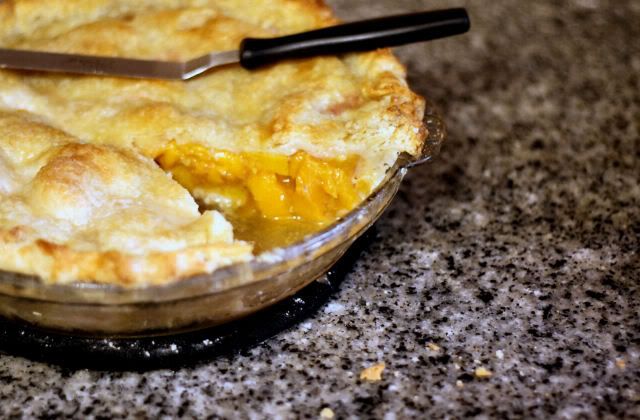
Here is the inside showing the peaches. I went with slicing, as the larger slices, as opposed to smaller dices, is because these peaches are already ripe and soft. Although they are canning peaches, they will soften too much (for my palate) if diced or made too small. Anyways, great color and texture, which I hope you can imagine.

And the aroma was incredible, fresh spices and peaches makes for a heady mix. As for the small spreader, it is an odd thing, but, somehow my pie server has gone missing. Odd really.

Grandpa Sahara's Pie Crustnow, there is nothing fancy here, it is a pie crust after all.

9 cups flour
4.5 cups shortening
1/2 T salt
1.75 cups water, ice cold
3T+ sugar

1. You do not sift, you simply toss the flour, salt and sugar together with a whisk. Refrigerate.

2. Cut shortening into small cubes, or large cubes if you are good, I am not good, so small cubes. Refrigerate.

3. On a flat surface, bowl flour and add shortening in middle, cut or pinch shortening into flour quickly, do not let warm up. I use a pastry cutter, my sister uses her fingers, she is better than I am and her pies are better than mine. Dammit!

4. The flour/shortening mixture should resemble a fine meal with chunks of larger pieces. Sprinkle the cold water over the flour lightly, then toss together to pull dough together. Note, it will not look like dough, it will look like larger granular material.

5. Fraisage, which means, taking your palm and flaking the flour, by pushing the dough into large flakes of dough. I do this rather quickly by just pushing down into the dough with my palm, quickly and with a slight smearing action.

6. Assemble the flaked dough onto plastic wrap, this recipe makes six crusts, so you will need six sheets of plastic wrap. Consolidate and wrap tightly, chill for one hour.

7. Roll and makes pies.

I use a mix of coconut palm oil and butter, Grandpa Sahara used Crisco, His crusts were flakier, mine taste better and are more tender. And that is what I am sticking too.

Sunday, August 7, 2011

Smoked Brisket Ramen

I have just received my copy of Lucky Peach, a new quarterly from the minds of Chef David Chang of Momofuku fame, writer Peter Meehan and the folks from Zero Point Zero Productions. If you have not read this amazing journal, and you like food, you need to get a copy. It is the best food writing I have read in a long time, maybe ever. The first issue is all about ramen. I love ramen. Suddenly, I need ramen. I think it is a heritage thing, those pesky ancestors of mine driving me to the noodle. Sadly there are no good ramen shops near home; I am left to my own devices, this is never good. But, there is often good food.
First, I need to make a few basics. I need a dashi, which is nothing more than a flavored broth, usually this is either fish or fowl based and fairly light in flavor and texture. Then, there is the tare, this is the intense flavoring that defines the dish, often this is miso, shoyu or salt.  Finally, there is a third item that most folks in the U.S. do not understand, or even realize is a part of traditional ramen, which is the fat.

Yes, the fat, often dressed over the dish, sometimes actually blended with the noodles first. I opted for a smoked brisket and bacon dashi, the tare will be a smoked brisket, bacon and shiitake infused shoyu, the fat is going to be a curried bacon/garlic infused smoked brisket, bacon fat skimmed from the broth, this was inspired by the work of Chef Danny Bowien at Mission Chinese Foods.
The whole success of this dish will rest on the 1/4 pound of smoked brisket point, 1/8 pound of uncured apple wood smoked bacon and the aromatics of 1/2 yellow onion and 1/2 of a large carrot. These were steeped along with a sheet of konbu in three cups of water at 150F for one hour. It must not boil. I then removed the konbu and all but 1 cup of broth. At this point, the remaining one cup was boiled hard for 20 minutes, I had to add a little water, until the meats and vegetables were completely reduce and the broth was milky with protein. I cut the heat, returned the reserved broth and added 1/8 cup of fish sauce and several turns worth of ground Phu Quoc black pepper. This was strained and refrigerated overnight.

The fat was skimmed, reheated with some more bacon (man gotta eat breakfast) and then the fat was turned off and 3 teaspoons of curry powder and some slivered garlic was added. This was allowed to cool. I will toss a teaspoon or so of this with the ramen noodles just after boiling.

Shiitake mushrooms were rehydrated and added to about 1/2 cup of the brisket broth, a shot of sherry, 1/8 cup of shoyu, 1 tablespoon of sugar and a few shots or so of fish sauce. This was reduced by half to create a thick syrup. This would be my tare.

Next, I purchased some fresh ramen noodles. But, next time, I will make them from the recipe in Lucky Peach. Some vegetables were procurred as well. One can't just eat fat and meat and expect good results, you need some fiber.
Well, that photo sort of blows, best one of a series of photos that somehow failed to be focused. What we have here are blanched bean sprouts, seared carrots, curried bacon lard, shiitake mushrooms stewed in the tare and a very soft boiled egg. Here is the bowl with the noodles and other stuff, including the fat, which I dolloped onto the top of the noodles.

Serving is as simple as cooking the noodles, placing them in the bowl and then the sliced vegetables are added, some seared brisket point and then the fat was placed on the noodles. ThenI drizzled the tare, a syrup really, over the vegetables and noodles.  I added a soft boiled egg, really a warmed egg, to the ramen and the dashi was poured over the top. The dashi has to be really hot to make it all work
Look at that bowl of goodness, those seared up slices of brisket point were tender with a wonderful crunch along the edges. The vegetables were also just right. Most importantly, the fat melted into the noodles and the egg got just enough heat to tighten up to a custardy consistency. I have to say, this was exceptional ramen, with a deep complex flavor and each ingredient offered it owns taste and texture, I really love that kind of clarity in food.

And you might say, it is a mish mash of styles and what of this fish sauce stuff. Well, of late, I have been giving a great deal of thought to the idea of authenticity, of what really defines a cuisine and how it "should" taste. I know of no other style of cooking than to take the best of what I have, to cook with it, to make good food. It is authentic to me, it is authentic to this place and time. Will you find this dish in Hiroshima, or Ibaraki, or Gifu, where my family hails from, I doubt it. But, I bet folks there would have enjoyed this bowl.

Thursday, August 4, 2011

New Camera and something else

Through the generosity of a friend (Rob Bergstrom of Red Boat) I have a new camera. New to me, it is a slightly used Canon 40D with a 50mm f1.8 lens. I am a happy boy, with a new toy. And so, having secured this new camera, I decided to test it out. Here is my first post shot with the new camera.
And what you ask is that stuff? It is salt. I can't go into much more detail at this point, other than to say that it is salt, from Vietnam.

Sunday, July 31, 2011

Lafitte San Francisco

Photography courtesy of Rob Bergstrom

Omakase, a term in Japanese that literally means 'it is up to you'. When stated to a sushi chef, it means give me your best and freshest. I believe amongst American Foodies, it has come to mean 'I am a daring and sophisticated eater'. At it's best, I believe it becomes a contract between the diner and chef, that each will play their part in making a memorable dining experience happen. I believe the key to this relationship is to test your own limitations and conceptions about food, to interact and give back to the chef. I think chefs love to cook for people, in the end, being a chef is about feeding peopleand the chef's table is that chance to truly make fine dining a communication to play off of each other.

I recently had the opportunity to 'Walk the Plank' at Lafitte, a restaurant established in San Francisco, and conned by Chef Russel Jackson, he of Subculture Dining fame. And he still seeks to push the envelope of there dining can go, Lafitte has a pirate inspired attitude in it's approach to food and dining, breaking rules where they need to be broken, stealing the moment, when it needs to be stolen. I met my friends Rob and Michael, frequent dining explorers and companions, as well as Michael's friend who joined us as well. Along with ourselves, a batch of sweet kumquats, some Red Boat fish sauce and some Phu Quoc black pepper also made the trip 'down the plank'.

Our first course was to be a Sourdough blini with a Nettle Aioli and sliced Summer Truffles, I considered this to be a bold start, with the nettle puree being added at the last minute to the aioli, the summer truffles being extravagant, and the sourdough blini providing a solid base of flavor for the other elements to play off of. One of the great things about 'walking the plank' is that the food is right there when being prepared.
The nettle puree, as you can see, is quite vibrant, it was spooned next to the aioli, and then a cake spreader painted it across the plate like a palette knife creating an abstract modernist canvas, then the blini and about 1/4 of a truffle each. Hand sliced instead of shaved really gives the truffle a textural role that is mostly missed when it is shaved or chopped. The slightly crumbly/crunchy texture is hard to reconcile to the earthy warm aroma and taste. The soft starchy blini and vegetal nettle each rolling across the palate created complexity. An outstanding and confident opening shot.
A note about first courses, I think many chefs will present a first course that is easily the simplest dish to be served, it allows for building the palate and courses throughout a dinner. The idea of sending out a first course that is really well conceived, deeply complex and beautiful sets a challenge for the rest of the meal. Our pairings were handled with aplomb by the bartender, whose name, unfortunately, I didn't have the good graces to get. And I should have, as she is an excellent mixologist and made some excellent pairings of both wine and cocktails for our dinner. In addition to that, she was engaging and challenging. This is her throwing some attitude at the camera. She provided us with a crisp white wine, if I remember correctly it was a Sauvignon blanc, not my favorite wine, but a great match.
Rob was enjoying a Bloody Mary when I got there, late, again, did I mention, I hate driving in San Francisco, I am late to everything there. Anyway, he was enjoying a Red Boat fish sauce infused Bloody Mary, did I mention the bartender was good, real good? It was excellent stuff.
The second course, traditionally a soup course was to be an eye opener for me. One of the reasons I dine out is to try out what chefs are doing, to seek out how other people are seeing food and crafting their vision in the kitchen. I can cook very well at home, and wouldn't suffer if I had to eat my own food. But, from time to time, I run across someone who redefines what an ingredient or cooking can be. A chef that is not just assembling food, but, is crafting a vision, is really cooking. Here is where Chef showed me his chops, he understands his ingredients and techniques. If this were a sea battle, I just lowered my colors. Here are the two main ingredients of the second course, one is easily identified, foie gras and the second, a perfectly smoked pork belly strip.

Yes, that is pork belly, not fat back, and it is from an Iberico pig. It was perfectly smoked and yet, it is a hunk of fat. I am no fan of foie gras or raw pork fat, I find them to be two textures that are just to much for me. But, like I said, I was about to be taken to school. In these bowls, are the smoked pork belly, some raw peas, barely cooked potatoes and a stuffed squash blossom, with the goat cheese infused with Phu Quoc black pepper that we had brought for Chef.
And that broth being poured into the bowls, well, it was something special, Chef never actually revealed what it was, but, it had a definite duck flavor, and the color was rich, I had seen some duck confit, so my guess is that it was a duck confit poaching liquid which was used to briefly poach the foie gras. Each bowl got a slice of meltingly tender poachedfoie gras to finish.
Not a huge portion, but, this is a slice of foie gras, over a slice of smoked pork belly with a deep fried squash blossom on top and draped with duck confit broth, do you need more than this? Is there something wrong with you? Nobody should eat something this rich. And the lesson, each element of this dish rocked, alone, with it's neighbors and as a whole. The foie gras was transformed, ephemeral in texture, delicate in flavor and perfectly balanced by the smoke of the pork fat. And let me just add, as someone that has been smoking meat for over 30 years, this pork belly was perfect, this was the finest smoked soup element I have ever encountered. Smoke can become cloying, even over powering in soup very quickly, this never happened with this soup. And, the smoke was gone just as soon as the dish was gone. Perfect.
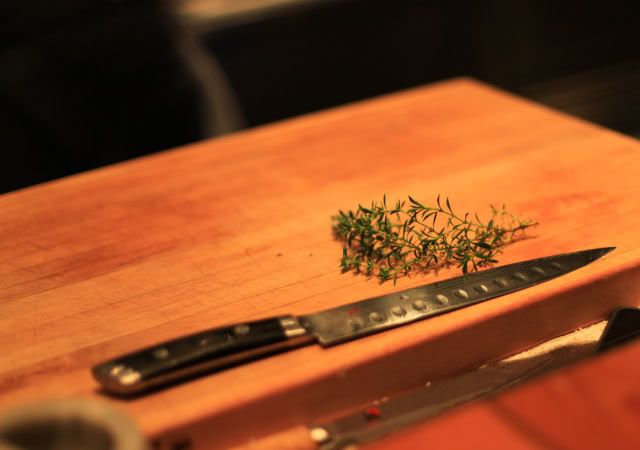
Above was course three, a pasta course and something that initially felt a little our of sorts. It was classic, perfectly classic. Did it have Red Boat in it? I sort of don't think so, although it would have been perfect for it. It was like the jazz musician who deftly weaves a little riff of classical music into a performance, as if to say 'yep, I can do that too'. This was pasta cooked al dente, with capers and herbs, a light tomato sauce, simply presented. Oh, and it lead to my getting a shot that I love, as I love knives, and Chef uses aWa-petty, a Wa-gyuto and  a Wa-santoku for his prep work.
And now on to the fourth course, which would be a course featuring salmon, I do not eat salmon, In particular, I do not like the texture of salmon skin and the fat along the skin. What can I say. But, there is that tacit agreement of omakase, oh what to do. Well, you have to try things. And I did notice that the salmon was beautifully prepared, with just the thin top half of the skin, the fatty horrid white part of the skin was gone. Braised greens, a light olive oil and a serious sear on the salmon, this seemed to be the plate, but, wait, is that a bottle of Red Boat (yes, we brought a bottle).
 Amazingly, Chef seemed to have a plan, he seemed to know that this sauce would go great dressed onto the salmon. How do great cooks have these kinds of instincts? He actually poured it over the salmon just before serving. The salmon skin remained crisp, according to everyone else who ate it. The salmon was actually good, the braised greens and excellent complement and the fish sauce unobtrusive, yet, providing a subtle reinforcement to all the flavors.
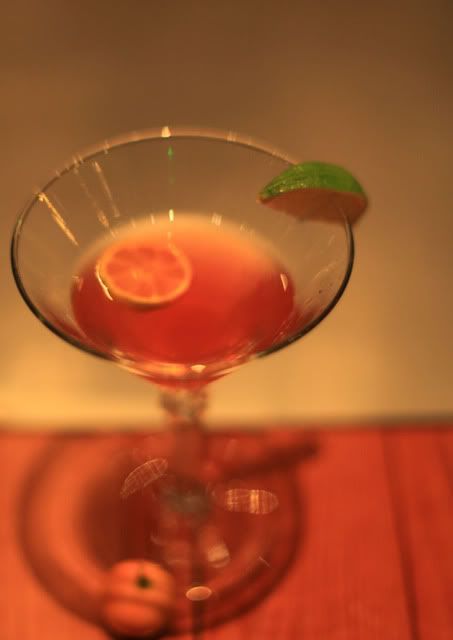
And to match the salmon, a surprise, as we had all expected the standard play, the Pinot gambit, but, our barkeep had other plans, she brought out the house cocktail, a Rio Nueovo, but, augmented boldly with the sweet kumquats we had brought along. The cachaca used in the drink was hand made, and signed by the maker. This was my second of these cocktails, but, the first one with the sweet kumquat, which changed the drink considerably, and I think for the better. This cocktail was all about impressive sourcing, along with a little elderberry syrup, this cocktail rocked with the salmon.
Oh, and it is a little known fact, but, it is critical that all 'cooks of the line' must be perfectly seasoned for the kitchen to work well. Here Chef is making fine seasoning adjustments.
On to course five, and course five was worth the wait, I learned of a cut of meat that has somehow escaped my knowledge thus far. It turns out, if you actually butcher a hog, you find a small part of the tenderloin that is along the rib cage, it is inconveniently shaped and ends up as trim. This is the most tender cut of pork I have ever had. It was marinated in Moroccan spices and served over puy lentils. It was an earthy and rich presentation, with the medium rare pork sitting atop, grilled perfectly and so tender.
The pairing to go with this dish was a earthy red wine, perfect for the dish. I am afraid that by this time, I was paying scant attention to the pairings, the food was just holding my attention completely at this point. The descriptions notwithstanding, I am more of a visceral eater, when I am eating truly fine food that holds my attention like this, I drop the idea of 'what I know' and give myself to the experience. This food fully realized what I had hoped for, I figured dessert would be anti-climatic. But, then she pulled out the port. I love port. In this case, a 10 year old Dow's Tawny. And this means chocolate.
 And yet one more last shot across my 'all knowing bow', a simple chocolate souffle. How unremarkable, I mean who doesn't do souffle, weee, eggy chocolate. Well, I have the port.
And so, after the first fork, I realize, this is some danged good souffle, the chocolate is so delicate and floral. In general, I can call the chocolate in a dessert. No kidding, I often get the chocolate down to the brand, sometimes even the source. This was nothing I knew and it was pure chocolate in expression. The pastry chef nailed her craft on this one. She said it was TCHO chocolate, this is something I will need to seek out. It was spectacularly fruity and delicate. I am not at all sure that it was not how she prepared the souffle, but, it was a singular end to an excellent and enjoyable meal. The port was a perfect pairing with it.
 
This meal would be memorable however because of how Chef and the kitchen and staff would interpret and present the ingredients for our dining. Now, one thing to note, almost without exception, all of us have foods we love, and foods we dislike, these can certainly affect our choices in how we react to food. This can be a limitation when choosing from a menu, but, when sitting at chef's table and asking him to cook at his whim, you must relinquish those tastes and try whatever is presented, after all, this is what 'omakase' is all about.