Okay Rachel, this is for you. I do have a few variations on tartar sauce, the major thing being home made versus store bought. I prefer making tartar sauce from scratch in terms of consistency of the sauce and overall control in ingredients. But, it is hard to beat the convenience of ready made mayonnaise.
Easy and Fast Tartar sauce:
3/4 cup Mayonnaise, Best Foods
1/8 cup heavy cream
2 tablespoons dill pickle juice
1 teaspoon Worcestershire sauce
1 teaspoon each chopped capers and pickles
1 teaspoon finely chopped onion or shallot (shallot is better, onion is cheaper)
1/2 teaspoon finely snipped chives and parsley combined
White pepper to taste
Combine mayonnaise, cream, pickle juice and Worcestershire sauce, adjust with half of cream first to get desired texture. You want a consistency that is slightly thicker than the cream itself. Should hold to spoon when tipped.
Add in vegetables and blend. Allow to sit for 15 minutes if possible. Season with white pepper to adjust heat level. Allow to sit and chill for additional 15 minutes or more for best results.
Not at all Easy and Fast Tartar sauce:
3/4 cup home made mayonnaise
1/8 cup heavy cream
2 tablespoons dill pickle juice
1 teaspoon Worcestershire sauce
1 teaspoon each chopped capers and pickles
1 teaspoon finely chopped onion or shallot (shallot is better, onion is cheaper)
1/2 teaspoon finely snipped chives and parsley combined
White pepper to taste
Making mayonnaise:
2 extra large fresh eggs. Pastuerized eggs will work, I really prefer to get very fresh local aggs
1-3/4 cups of oil, normally I use a very good olive oil (grapeseed oil is a great choice too)
1/4 teaspoon fine salt (I use fine sea salt)
1-1/2 tablespoons lemon juice (or vinegar)
1/2 teaspoon mustard powder
Blend egg yolks thoroughly, this can be done by hand, I use a food processor (more to follow). Do something with the egg whites, you don't need them for this. Add the mustard powder. Now, you must add the oil very slowly, go too fast an it will not emulsify. Here is why I use a food processor, most of them have a pusher that has a small hole in the bottom of the pusher for the feed tube. If you fill this with half of the oil, it will trickle in at just the correct flow. If you go by hand (I will use a whisk sometimes) then you need to add a drop or two every few seconds. Once the oil is completely incorporated, add the lemon juice and salt. Taste and adjust salt.
Note: the mustard powder is not needed and some people dislike it. But, mustard powder is a great emulsifier and makes creating the egg/oil emulsion much easier.
Now, on to the Tartar Sauce...
Combine
mayonnaise, cream, pickle juice and Worcestershire sauce, adjust with
half of cream first to get desired texture. You want a consistency that
is slightly thicker than the cream itself. Should hold to spoon when
tipped.
Add in vegetables and blend. Allow to sit for 15 minutes if possible. Season with white pepper to adjust heat level. Allow to sit and chill for additional 15 minutes or more for best results.
To make this into Remoulade:
Delete the pickle juice, add champagne vinegar
Delete the pickles, double capers
Add finely chopped celery
Delete chives, add tarragon in it's place
Friday, September 7, 2012

Tuesday, September 4, 2012
Aloha Tri-tip
Now, you;'re probably wondering what about tr-tip is Pacific Rim, well, it is just that, as I used a rub from the Aloha Spice Company, their Organic Aloha Prime Steak Seasoning and Rub. I received this from a friend, Rob, who was on a visit to the islands, and as he met our friend Roy, this package came to be purchased. Now, the only two things that appear to make this Hawaiian are the fact that it is made there and that it has 'Alaea salt in it. And that is good enough for me, I have grown up with the use of 'Alaea salt as a seasoning, and steak is especially good with it.
I had a tri-tip, a nice Choice Black Angus tri-tip in fact, and it was to be the test vehicle for this. I also decided to break out my Weber Smokey Joe Gold mini-kettle. This was a gift from my brother, and I have been meaning to run a cook on it. So, the tri-tip was liberally covered with the rub, wrapped in butcher paper and allowed to sit while I fired up the mini-kettle.

From here, the kettle was filled with lump, fired up and allowed to come to temperature, which was around 225F, indeed, I would do this low-n-slow up to 115F internal, at least that was the plan. The kettle-ette was rocking in no time, I am already seeing benefits here. So the meat hit the grate.

So, the texture of the rub is a little coarser than I normally like, I prefer a medium grained texture and no whole spices, but, it was a gift and deserves and open mind. You can see it gets a great color and there are a lot of spices present. The kettle was closed and about 30 minutes passed, a quick flip and another 30 minutes, check internal, 100F, okay, another 10 minutes, 135F internal WTF!!! Off the kettle. No sear. How did it climb so fast? There must have been operator error here.

Well, just in time, off to rest under a foil tent for 20 minutes. You always want to let the meat rest, a small cut like this, 20 minutes is perfect. You could go longer actually. In any event, a few slices and here it goes, a nice medium in my books. I was hoping for medium rare, but, well, operator error is what it is.

There was plenty of moisture left in the meat, it tasted great, with the beef still from and center, but, the edges had a great balance of spices and salt, a very nice nip of chile and black and white pepper, this is a good rub. It was a little too coarse, but, I will use it again. Glad I have some more.

There is nothing easier than working with good meat in a kitchen, and this cut did not disappoint. I know many folks are tuning in to the fact that even with a Certified Black Angus label, not all Angus beef is really from true Black Angus cattle. Since the ranch this is purchased from offers registration and tracking of it's animals, the lineage is a true Angus. With great beef and a very good rub, dinner tasted great. That meat was as tender and moist at the photos look.
I had a tri-tip, a nice Choice Black Angus tri-tip in fact, and it was to be the test vehicle for this. I also decided to break out my Weber Smokey Joe Gold mini-kettle. This was a gift from my brother, and I have been meaning to run a cook on it. So, the tri-tip was liberally covered with the rub, wrapped in butcher paper and allowed to sit while I fired up the mini-kettle.
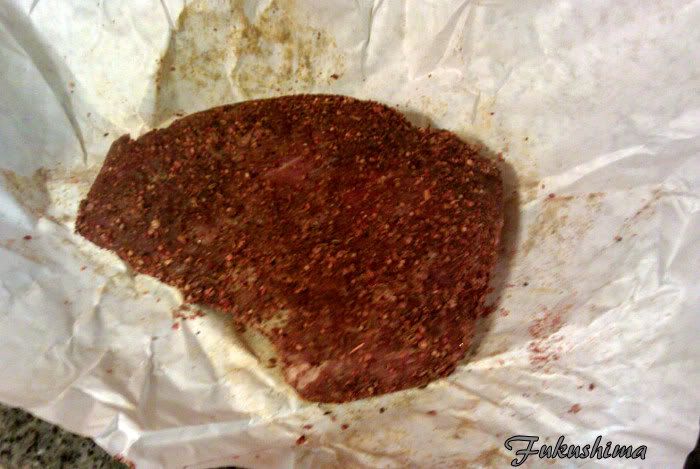
Rubbed up
From here, the kettle was filled with lump, fired up and allowed to come to temperature, which was around 225F, indeed, I would do this low-n-slow up to 115F internal, at least that was the plan. The kettle-ette was rocking in no time, I am already seeing benefits here. So the meat hit the grate.
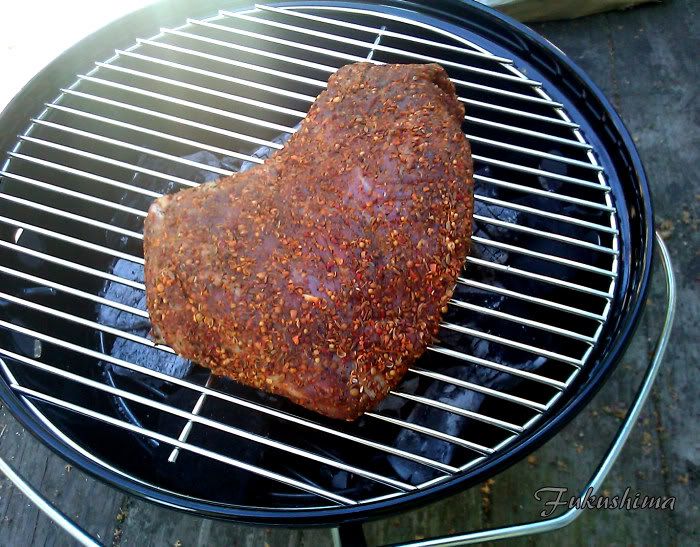
Meat On!
So, the texture of the rub is a little coarser than I normally like, I prefer a medium grained texture and no whole spices, but, it was a gift and deserves and open mind. You can see it gets a great color and there are a lot of spices present. The kettle was closed and about 30 minutes passed, a quick flip and another 30 minutes, check internal, 100F, okay, another 10 minutes, 135F internal WTF!!! Off the kettle. No sear. How did it climb so fast? There must have been operator error here.
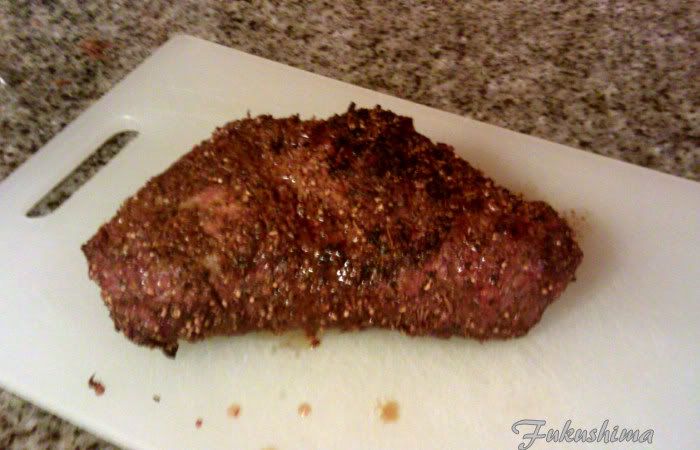
Meat Off! Meat Off!
Well, just in time, off to rest under a foil tent for 20 minutes. You always want to let the meat rest, a small cut like this, 20 minutes is perfect. You could go longer actually. In any event, a few slices and here it goes, a nice medium in my books. I was hoping for medium rare, but, well, operator error is what it is.
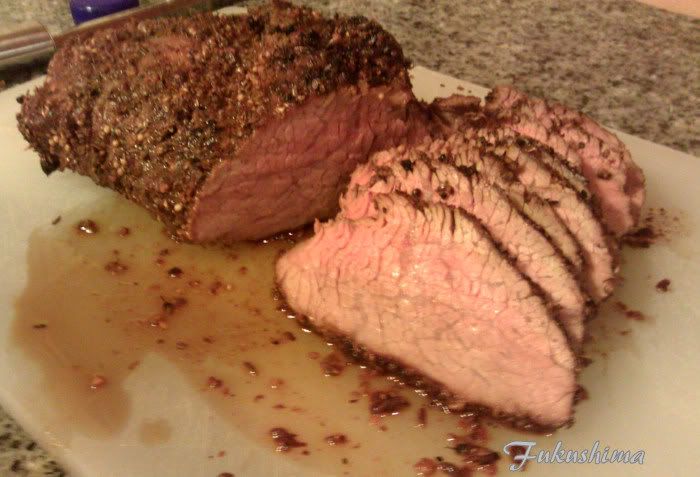
Yeah, I can eat this
There was plenty of moisture left in the meat, it tasted great, with the beef still from and center, but, the edges had a great balance of spices and salt, a very nice nip of chile and black and white pepper, this is a good rub. It was a little too coarse, but, I will use it again. Glad I have some more.
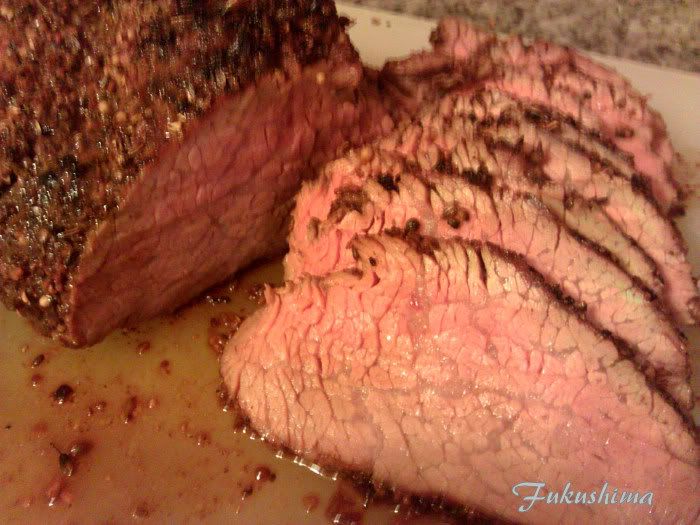
A close-up
There is nothing easier than working with good meat in a kitchen, and this cut did not disappoint. I know many folks are tuning in to the fact that even with a Certified Black Angus label, not all Angus beef is really from true Black Angus cattle. Since the ranch this is purchased from offers registration and tracking of it's animals, the lineage is a true Angus. With great beef and a very good rub, dinner tasted great. That meat was as tender and moist at the photos look.
Sunday, September 2, 2012
Pizza-the long dough home
I made some pizza, this was all stated when people kept mentioning pizza within earshot and Facebook shot of me. Suddenly I had to have pizza. Of course, nothing is ever simple around here. Since I am terrible at keeping a sourdough starter alive, I have been playing around with preferments for dough. Not unlike a Biga, but, with a slightly longer process in my case.
It starts with 1 package of commercial bread yeast, 1 teaspoon of fine sugar and 1 cup of warm water. This is all mixed together and allowed to sit, in the bowl, open, for 4 hours. Then it is closed off and placed in the refrigerator for another 12 or so hours, I am shooting for a slight, but, controlled fermentation of the starter. At this point, the starter will have a slight aroma, but, not the strong odor of a true sour starter. I mix up 2 cups of Caputo 00 flour, 1 teaspoon of fine salt, 1.5 teaspoons of a very good olive oil and an additional 1/2 cup of warm water. This is all tossed into the mixer with a dough hook, and worked for 10 minutes. The dough should pull cleanly from the bowl. I go straight to a oiled bowl and cover with plastic wrap, then into the refrigerator for another 24 hours.

It is then time to form the balls, one for a large pizza, or four for a smaller 9" pie. Let them proof for a few hours. I like to proof my dough in a pan, covered loosely with plastic wrap and in a cold oven, it adds a little stability to the process of proofing. Here is the dough for proof.

Once they are proofed, the balls will have spread out, this is a very soft dough, it really needs to be handled with floured hands and worked quickly. It has a lot of spring, so it is ideal for a thin roll out or pulled crust. I worked these out to about 9" or so, topped lightly and onto the kettle running as hot as it would go, with lump and apple wood. The pizzas were cooked on a cast iron pizza pan, which works great for this. I will line the top of the kettle with a little foil, this aids in browning.
Oh, and the sauce, well, everything, this is the season of plenty in California right now, so the sauce was a raw sauce of seeded and pureed organic Early Girl tomatoes, basil, Italian Parsley, a very good olive oil and a little organic garlic.

This along with some great cheese, Maldon salt flakes, fresh ground pepper, makes for some great pizza. For instance...


The dough performed beautifully, had just a hint of sourness and sprang nicely in the heat, the crisp surface and tender sponge worked great. The sauce was exceptional, just cooked, it was sweet and sang of tomatoes, the herbs and cheese working just off the edges. It was just an excellent cook.
It starts with 1 package of commercial bread yeast, 1 teaspoon of fine sugar and 1 cup of warm water. This is all mixed together and allowed to sit, in the bowl, open, for 4 hours. Then it is closed off and placed in the refrigerator for another 12 or so hours, I am shooting for a slight, but, controlled fermentation of the starter. At this point, the starter will have a slight aroma, but, not the strong odor of a true sour starter. I mix up 2 cups of Caputo 00 flour, 1 teaspoon of fine salt, 1.5 teaspoons of a very good olive oil and an additional 1/2 cup of warm water. This is all tossed into the mixer with a dough hook, and worked for 10 minutes. The dough should pull cleanly from the bowl. I go straight to a oiled bowl and cover with plastic wrap, then into the refrigerator for another 24 hours.
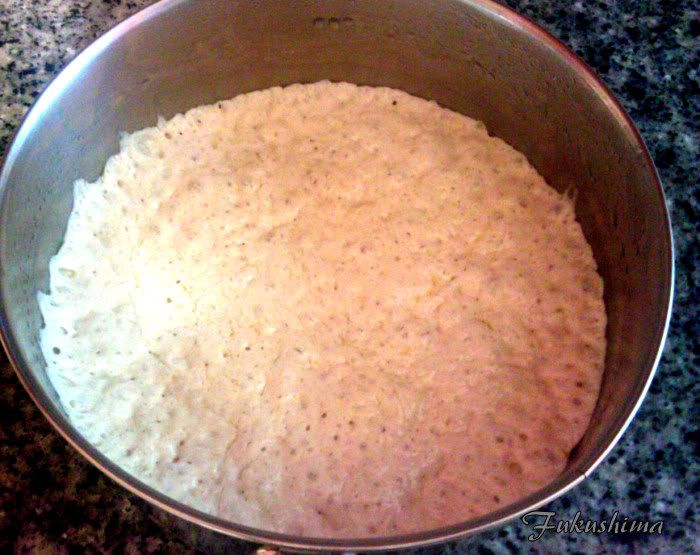
After 24 hours, sooo bubbly
It is then time to form the balls, one for a large pizza, or four for a smaller 9" pie. Let them proof for a few hours. I like to proof my dough in a pan, covered loosely with plastic wrap and in a cold oven, it adds a little stability to the process of proofing. Here is the dough for proof.
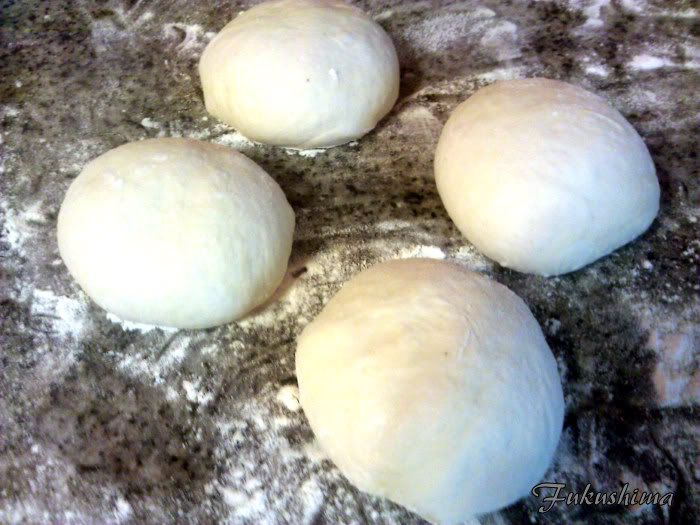
Dough balls, they look so good at this point
Once they are proofed, the balls will have spread out, this is a very soft dough, it really needs to be handled with floured hands and worked quickly. It has a lot of spring, so it is ideal for a thin roll out or pulled crust. I worked these out to about 9" or so, topped lightly and onto the kettle running as hot as it would go, with lump and apple wood. The pizzas were cooked on a cast iron pizza pan, which works great for this. I will line the top of the kettle with a little foil, this aids in browning.
Oh, and the sauce, well, everything, this is the season of plenty in California right now, so the sauce was a raw sauce of seeded and pureed organic Early Girl tomatoes, basil, Italian Parsley, a very good olive oil and a little organic garlic.
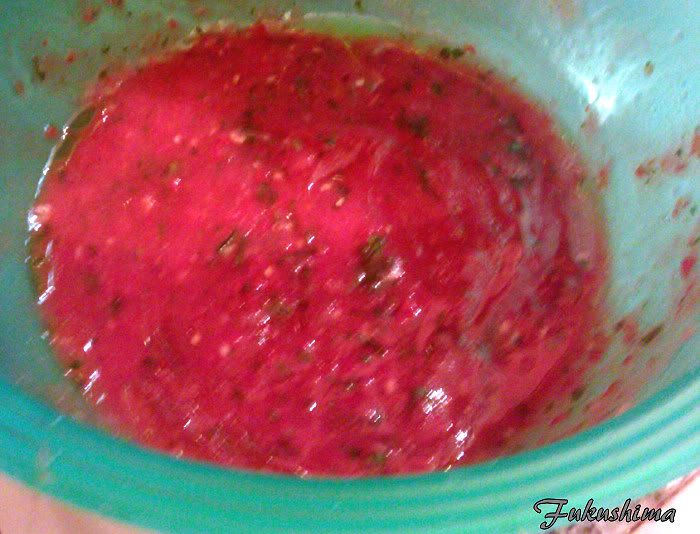
Early Girl sauce
This along with some great cheese, Maldon salt flakes, fresh ground pepper, makes for some great pizza. For instance...
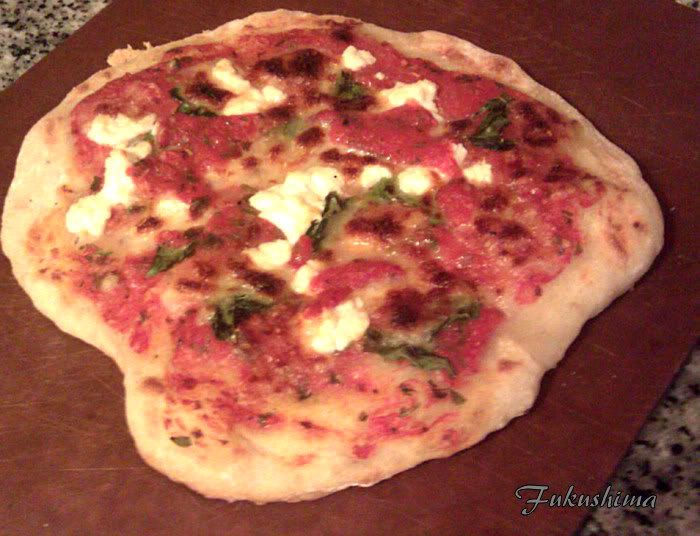
Pizza Margherita
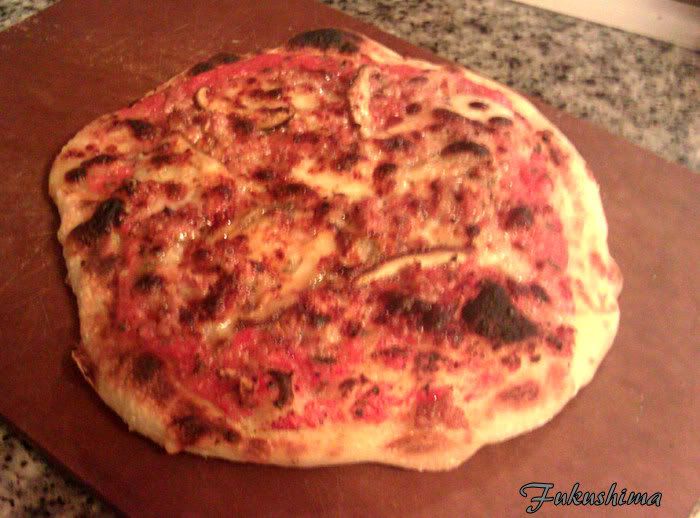
Sausage and Mushroom
The dough performed beautifully, had just a hint of sourness and sprang nicely in the heat, the crisp surface and tender sponge worked great. The sauce was exceptional, just cooked, it was sweet and sang of tomatoes, the herbs and cheese working just off the edges. It was just an excellent cook.
Saturday, September 1, 2012
Izakaya Yazuki and the meaning of food
I recently heard about a new restaurant, in Japanese terms it would be called an Izakaya, not really a place meant to be for eating dinner, so much as a place to grab a snack and some sake. And although it is not my norm to write restaurant reviews, as there are so many who do a better job of that, I feel that there is an interesting element to this experience, at least for me. It has to do with the role that food plays at an emotional level. To be sure, the food at Yazuki is well executed and the use of both local and Japanese ingredients is quite typical for any restaurant hitting the scene in San Francisco needs to have. But, they use nuka and koji in many of their dishes.
Koji, which is a mold, is a traditional ingredient for making fermented foods in Japan, it is one of those ingredients that defines a cuisine, you truly do not have real Japanese food without the effects of Koji and it's by products of nuka, sake and shoyu. Yazuki has chosen to focus on these ingredients and the effect they have on aroma, taste and texture. And the effect was stunning to me.
I grew up in a American household, quite typical in many ways, but, the one way were varied widely from our surrounding culture was in our food. My grandmothers used ingredients, such as nuka, miso, shoyu and sake, these ingredients informed the aromas in our kitchens. We always had preserved, femernted and pickled vegetables that were in various stages of each process. This is the food of my childhood, and I rarely taste anything like it. I taste it at Yazuki. I ordered the Tsunemono and something called Pirikara Kuri, the first taste of the Pirikara brought me great pleasure, as it was both subtle yet had a depth and complexity that is hard to explain, the food had the spice from Shichimi, a complex chili powder typical of Japanese modern cuisine and the particular texture of aged Japanese pickles, that I can only describe as barely wilted.

Then there was the Tsunemono, the highlight of the night for me actually. I could have eaten just this and some great rice and my night would have been made. The taste and texture of these fermented vegetables, which are left in nuka, a fermented rice bran product. Called, more properly, Nukazuke, this dish was instantly as familiar as my childhood, the aromas and textures, as well as the very vegetables were what I associated with my grandmothers kitchens. Emotionally, this hit me in the heart. I live for moments like this, were a food or drink evokes memories, that are so tangible and real, not some distant fog of memory, but, a visceral reaction. At that point, I was alone at my table, eating pickles, dead sober and having the best dining experience of my year. Perhaps many years, as I was, in a very direct way, dining with my mother and grandmothers.

This is the power of food to me, I have rarely seen it. I can remember only a few time, the most recent being on my 40th birthday, my dads 77th birthday, when I could not be with him. My friends Arleigh and Diane brought a bottle of wine that recalled the scents of the old California Flower Market, it tasted of the air in the market, it brought tears to my eyes. Only one other time, when I saw my dad tear up, as he ate home made Satsuma Age and he mentioned how it tasted of his mother's cooking, have I seen something as emotionally satisfying. The power of an aroma or a taste, to transcend decades, to defy age, and to bring one back to that those feelings and memories.
The final dish that had this effect, a tofu, sukui tofu, a soft, freshly made tofu, which, as a result of not being aged, is so soft, it takes the shape of the basket in which it is made, is another all to rare dish, we can buy kinugoshi tofu, which is similar but lacks the delicacy and immediancy of the freshly made tofu. Usually served with condiments, in this case a flavored shoyu, flake salt and minced herbs of ginger, scallion and garlic, this dish was something that as a child, I hated. It was just not right, but, as an adult, I find tremendous satisfaction and joy in this dish. I cannot help but be reminded of all those times I pushed it away, only to be told by my parents that someday, you will love eating it. And they were right, again.

There were other dishes, all of which were very well executed and had a hallmark of the cuisine I grew up knowing as Japanese food, which is a subtlety in the flavors. Japanese cuisine in America is all too often adjusted to satisfy the much stronger flavors and textures of the American palate. The Japanese cuisine I grew up with has layers and flavors that float across the palate, but, they need to be considered. Each dish, even the tempura, which bore an amazingly delicate crust, not over every bit of the meat or vegetable, but, just enough to add a bit of crunch and flavor, the shoyu that was light and complex, even the use of green tea salt, a delicate complexity on normal salt, all spoke to a Japanese meal prepared in a Japanese manner.
A Glossary of Terms:
Shoyu - soy sauce in English
Miso - fermented bean paste
Kuri - Cucumber
Koji - a mold, one of two types of fungus used in production of sake, miso
Zuke - fermented vegetable
Tsunemono - 'pickled things', normally reserved for vinegar pickles
(and finally, sorry about the phone pics, terrible, I loaned my camera out to a friend running for office)
Koji, which is a mold, is a traditional ingredient for making fermented foods in Japan, it is one of those ingredients that defines a cuisine, you truly do not have real Japanese food without the effects of Koji and it's by products of nuka, sake and shoyu. Yazuki has chosen to focus on these ingredients and the effect they have on aroma, taste and texture. And the effect was stunning to me.
I grew up in a American household, quite typical in many ways, but, the one way were varied widely from our surrounding culture was in our food. My grandmothers used ingredients, such as nuka, miso, shoyu and sake, these ingredients informed the aromas in our kitchens. We always had preserved, femernted and pickled vegetables that were in various stages of each process. This is the food of my childhood, and I rarely taste anything like it. I taste it at Yazuki. I ordered the Tsunemono and something called Pirikara Kuri, the first taste of the Pirikara brought me great pleasure, as it was both subtle yet had a depth and complexity that is hard to explain, the food had the spice from Shichimi, a complex chili powder typical of Japanese modern cuisine and the particular texture of aged Japanese pickles, that I can only describe as barely wilted.
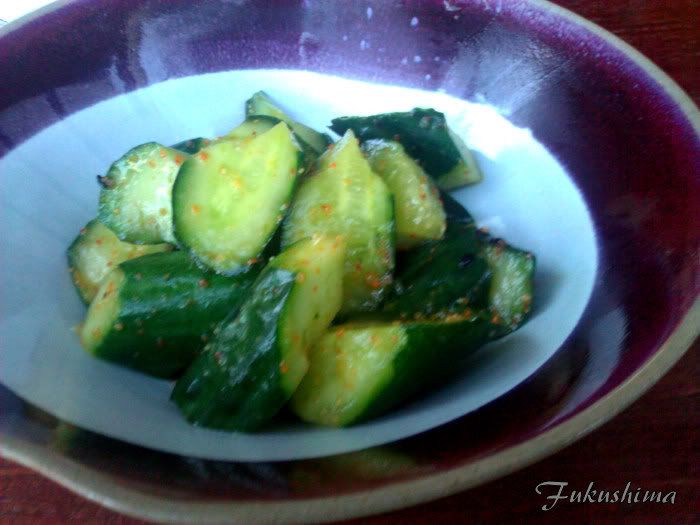
Pirikara Kuri
Then there was the Tsunemono, the highlight of the night for me actually. I could have eaten just this and some great rice and my night would have been made. The taste and texture of these fermented vegetables, which are left in nuka, a fermented rice bran product. Called, more properly, Nukazuke, this dish was instantly as familiar as my childhood, the aromas and textures, as well as the very vegetables were what I associated with my grandmothers kitchens. Emotionally, this hit me in the heart. I live for moments like this, were a food or drink evokes memories, that are so tangible and real, not some distant fog of memory, but, a visceral reaction. At that point, I was alone at my table, eating pickles, dead sober and having the best dining experience of my year. Perhaps many years, as I was, in a very direct way, dining with my mother and grandmothers.
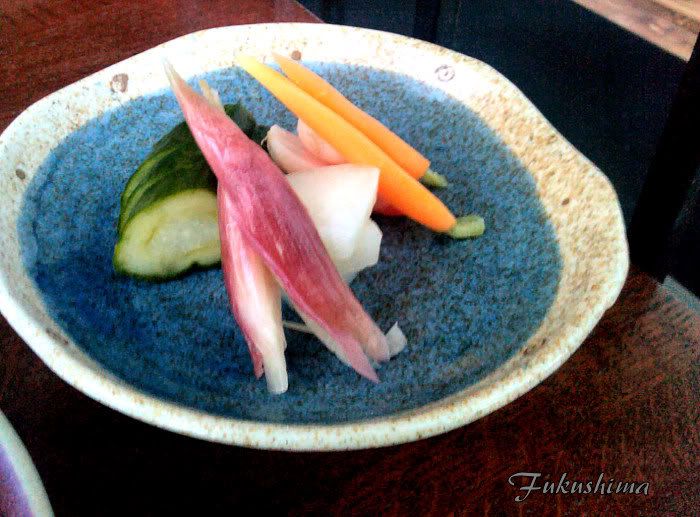
Tsunemono/Nukazuke
This is the power of food to me, I have rarely seen it. I can remember only a few time, the most recent being on my 40th birthday, my dads 77th birthday, when I could not be with him. My friends Arleigh and Diane brought a bottle of wine that recalled the scents of the old California Flower Market, it tasted of the air in the market, it brought tears to my eyes. Only one other time, when I saw my dad tear up, as he ate home made Satsuma Age and he mentioned how it tasted of his mother's cooking, have I seen something as emotionally satisfying. The power of an aroma or a taste, to transcend decades, to defy age, and to bring one back to that those feelings and memories.
The final dish that had this effect, a tofu, sukui tofu, a soft, freshly made tofu, which, as a result of not being aged, is so soft, it takes the shape of the basket in which it is made, is another all to rare dish, we can buy kinugoshi tofu, which is similar but lacks the delicacy and immediancy of the freshly made tofu. Usually served with condiments, in this case a flavored shoyu, flake salt and minced herbs of ginger, scallion and garlic, this dish was something that as a child, I hated. It was just not right, but, as an adult, I find tremendous satisfaction and joy in this dish. I cannot help but be reminded of all those times I pushed it away, only to be told by my parents that someday, you will love eating it. And they were right, again.
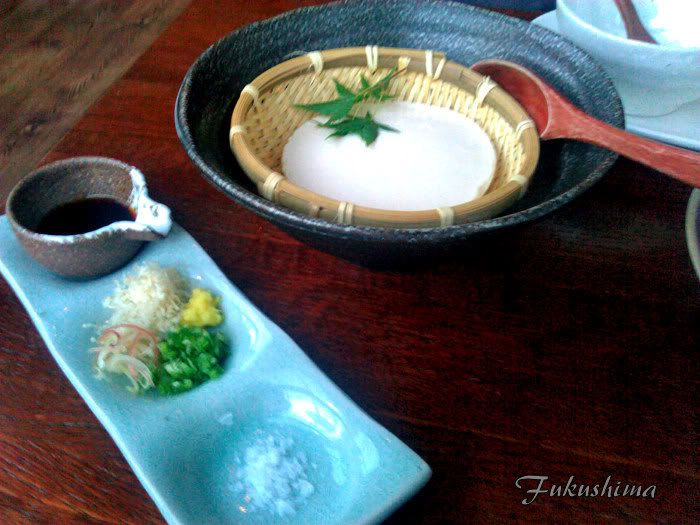
Sukui Tofu with Condiments
There were other dishes, all of which were very well executed and had a hallmark of the cuisine I grew up knowing as Japanese food, which is a subtlety in the flavors. Japanese cuisine in America is all too often adjusted to satisfy the much stronger flavors and textures of the American palate. The Japanese cuisine I grew up with has layers and flavors that float across the palate, but, they need to be considered. Each dish, even the tempura, which bore an amazingly delicate crust, not over every bit of the meat or vegetable, but, just enough to add a bit of crunch and flavor, the shoyu that was light and complex, even the use of green tea salt, a delicate complexity on normal salt, all spoke to a Japanese meal prepared in a Japanese manner.
A Glossary of Terms:
Shoyu - soy sauce in English
Miso - fermented bean paste
Kuri - Cucumber
Koji - a mold, one of two types of fungus used in production of sake, miso
Zuke - fermented vegetable
Tsunemono - 'pickled things', normally reserved for vinegar pickles
(and finally, sorry about the phone pics, terrible, I loaned my camera out to a friend running for office)
Wednesday, August 1, 2012
Peach Pie-Masumoto Peaches
Much like last year, I came across the opportunity to score some incredible peaches and nectarines from Masumoto Farms. Masumoto Farms in an old farm that specializes in stone fruits, and has a few old Elberta peaches and nectarines, the variety of which escapes me. No matter, here is what I stated with, by my estimation, just enough for one pie.

From this point, the option to just eat them made some sense, but, these were so ripe, and I really don't react well to eating 4 pounds of peaches and nectarines in one day. I don't think they would have held for another day or two. These are fruit that are picked ripe from the tree, and they were picked on Sunday. I did the standard peeling method of dipping in boiling water for 30 seconds, then blanch in ice water and slip the skins. Then into a soaking solution of 4 cups water and 2 tablespoons lemon juice (or other suitable acid). I prepared a spiced sugar mix like this:
3/4 cup fine sugar
1/8 teaspoon each cinnamon, allspice, mace, nutmeg
1/8 teaspoon fine salt
1 teaspoon each water, whiskey and lemon juice
The peaches were dumped into this mix and allowed to macerate for one hour.

This was to draw out some liquid from the peaches, in part to aid in cooking them, in part to get the soaking syrup for the pie filling. The juices were drained into a pan, 2 tablespoons of cornstarch were added and brought to a simmer until thickened. The peaches and nectarines were added back in and the entire mixture heated through. The peaches were about half cooked. Allowed to cool, they were ready for the crust. I used my typical Grandpa Sahara's pie crust, and decided on a lattice top. One thing I always do is coat the inside of the bottom crust with a egg and cream wash, which keeps the bottom crust dry and non-leaking.
A short while later, well, okay, an hour later...

After an initial bake at 450F for 10 minutes, and then another 45 minutes or so at 350F (I tend not to time, I check at 30 minutes for done and make a decision at that point). The peaches will be done no matter what as they were precooked. A pie like this needs to cook almost completely, Since I do not own a pie safe, I cover it lightly with a cotton cloth and let it sit for 2 hours at least. Here, with a little whipped cream lightly sweetened with agave syrup (much easier to whip cream using an invert syrup) is my Peach and Nectarine Bourbon Pie.

In final review, the taste was right there, a great pie, the peaches shine through, with just enough complexity to add to the flavor. It is concievable that I would forgoe some of the spices, just to let the peaches shine a bit more. Appearance wise, the overall lattice and liquid was detracitng for me, I was not careful enough with making the lattice. But, it eats just fine.
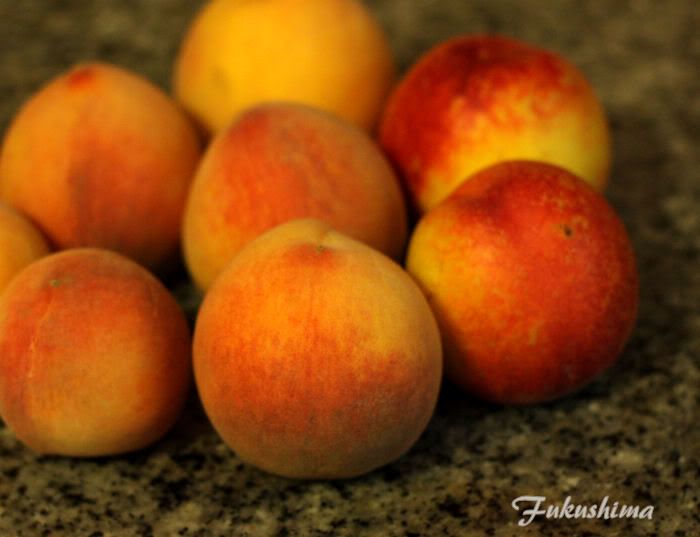
Peaches and Nectarines
From this point, the option to just eat them made some sense, but, these were so ripe, and I really don't react well to eating 4 pounds of peaches and nectarines in one day. I don't think they would have held for another day or two. These are fruit that are picked ripe from the tree, and they were picked on Sunday. I did the standard peeling method of dipping in boiling water for 30 seconds, then blanch in ice water and slip the skins. Then into a soaking solution of 4 cups water and 2 tablespoons lemon juice (or other suitable acid). I prepared a spiced sugar mix like this:
3/4 cup fine sugar
1/8 teaspoon each cinnamon, allspice, mace, nutmeg
1/8 teaspoon fine salt
1 teaspoon each water, whiskey and lemon juice
The peaches were dumped into this mix and allowed to macerate for one hour.
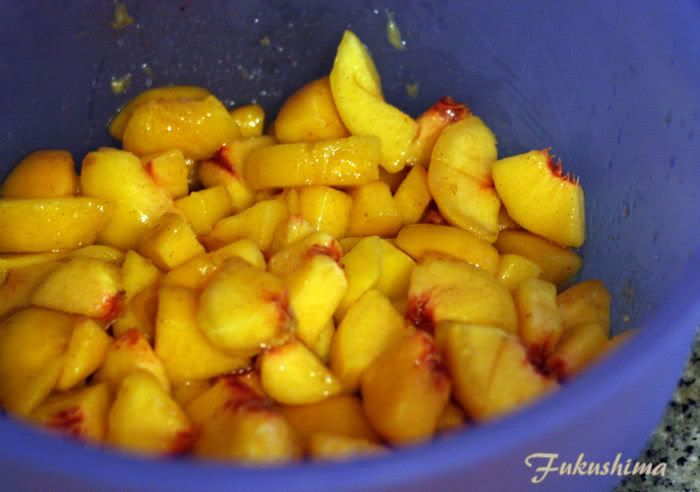
Macerating Fruit
This was to draw out some liquid from the peaches, in part to aid in cooking them, in part to get the soaking syrup for the pie filling. The juices were drained into a pan, 2 tablespoons of cornstarch were added and brought to a simmer until thickened. The peaches and nectarines were added back in and the entire mixture heated through. The peaches were about half cooked. Allowed to cool, they were ready for the crust. I used my typical Grandpa Sahara's pie crust, and decided on a lattice top. One thing I always do is coat the inside of the bottom crust with a egg and cream wash, which keeps the bottom crust dry and non-leaking.
A short while later, well, okay, an hour later...
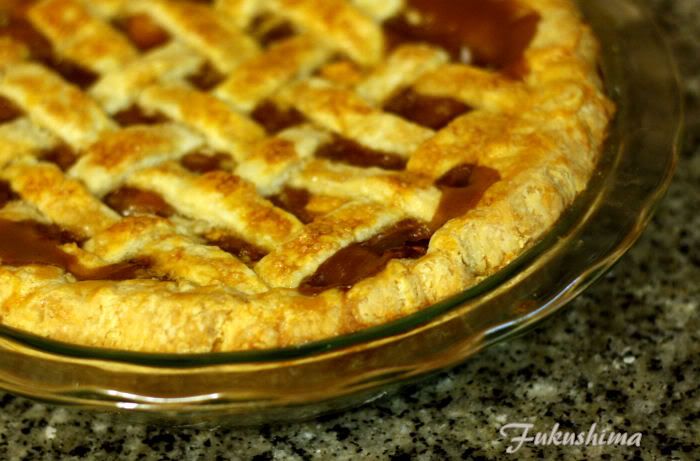
Whole Pie
After an initial bake at 450F for 10 minutes, and then another 45 minutes or so at 350F (I tend not to time, I check at 30 minutes for done and make a decision at that point). The peaches will be done no matter what as they were precooked. A pie like this needs to cook almost completely, Since I do not own a pie safe, I cover it lightly with a cotton cloth and let it sit for 2 hours at least. Here, with a little whipped cream lightly sweetened with agave syrup (much easier to whip cream using an invert syrup) is my Peach and Nectarine Bourbon Pie.
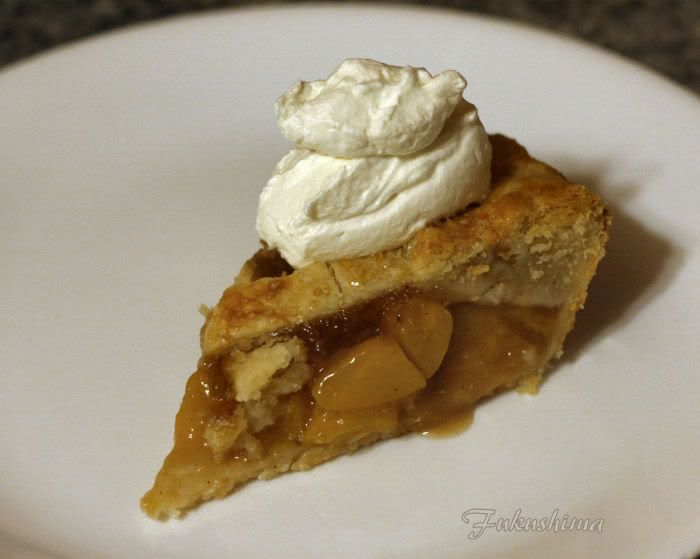
Yes, that is enough for one
In final review, the taste was right there, a great pie, the peaches shine through, with just enough complexity to add to the flavor. It is concievable that I would forgoe some of the spices, just to let the peaches shine a bit more. Appearance wise, the overall lattice and liquid was detracitng for me, I was not careful enough with making the lattice. But, it eats just fine.
Tuesday, June 5, 2012
Smoked Pork 'Carnitas'-style
So, on Sunday, I cooked up a load of meat, including two pork butts that I was able to score at the local wholesale distributor. One of these cooked up perfectly within my time constraints, the other was more stubborn. I pulled it before it was ready. Thus it came about, that I had a not-quite-ready to pull butt. What to do...

I decided to make a 'Carnitas'-style dish, I love carnitas, the traditional Mexican dish, of slow cooked pork that is rendered and cooked in it's own fat. I like the use of smoked pork as a riff on this, as it adds another dimension to the meat. I took the stubborn butt, chunked it up. I also prepared some lime, orange, garlic, jalapeno and onion. I briefly sauteed the these vegetables and fruit, then added the pork. I ended up adding a little extra peanut oil to get the rendering started.

I then added the chunked up pork, note that I used cast iron, I just don't believe there is a better material or type of pan for this kind of cooking. The chunks were slowly fried and they continued to render into the pan. This results in additional caramelization as well as the added depth of flavor from the fruits and vegetables.

From here, I increase the heat to start creating a crust and crisping the surfaces. This process also creates some shredding and refines the texture of the meat. It may look chewy, but, it has just a crisp surface and a melting texture in the mouth.

From here, it can easily be used for tacos or burritos, or my preference, with rice and fresh fruit. I like pairing oranges and melon with some rice, chile sauce and this meat. The fresh fruit picks up the flavors in the meat while adding a nice cooling element to the dish. Something like an acidic cole slaw would also be great, with that great acidity cutting through the fatty pork.

Pork Butts and Ribs
I decided to make a 'Carnitas'-style dish, I love carnitas, the traditional Mexican dish, of slow cooked pork that is rendered and cooked in it's own fat. I like the use of smoked pork as a riff on this, as it adds another dimension to the meat. I took the stubborn butt, chunked it up. I also prepared some lime, orange, garlic, jalapeno and onion. I briefly sauteed the these vegetables and fruit, then added the pork. I ended up adding a little extra peanut oil to get the rendering started.
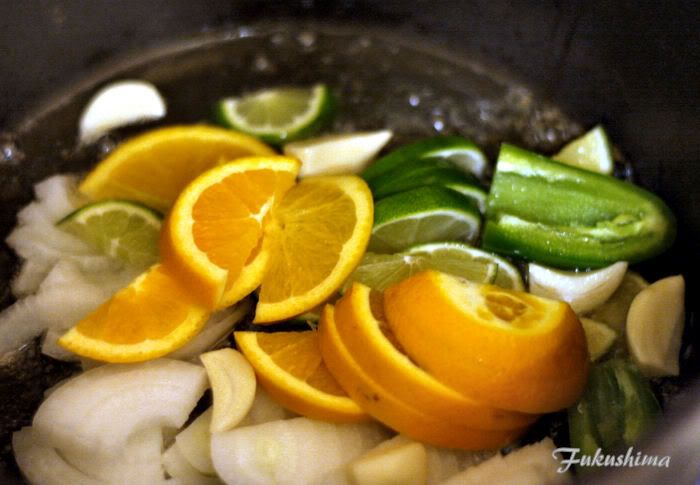
Fruit and Vegetables
I then added the chunked up pork, note that I used cast iron, I just don't believe there is a better material or type of pan for this kind of cooking. The chunks were slowly fried and they continued to render into the pan. This results in additional caramelization as well as the added depth of flavor from the fruits and vegetables.

Chunked Pork
From here, I increase the heat to start creating a crust and crisping the surfaces. This process also creates some shredding and refines the texture of the meat. It may look chewy, but, it has just a crisp surface and a melting texture in the mouth.
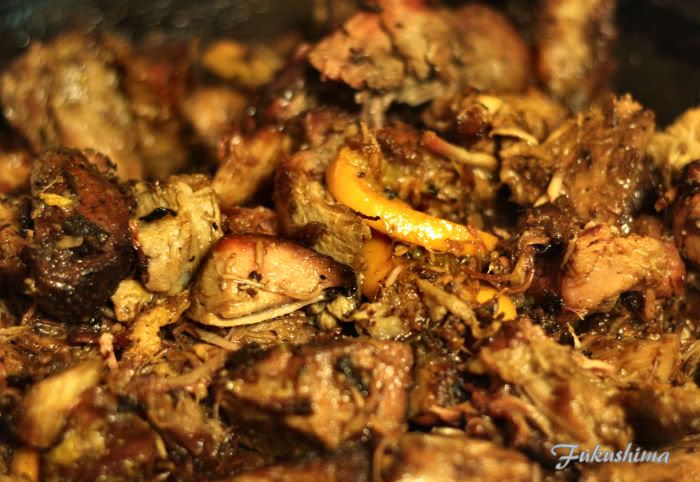
Ready for the Tortilla,,,or...
From here, it can easily be used for tacos or burritos, or my preference, with rice and fresh fruit. I like pairing oranges and melon with some rice, chile sauce and this meat. The fresh fruit picks up the flavors in the meat while adding a nice cooling element to the dish. Something like an acidic cole slaw would also be great, with that great acidity cutting through the fatty pork.
Tuesday, April 24, 2012
Parchment Wrapped Chicken
Today the subject of Parchment Wrapped Chicken came up, actually foil wrapped, but anybody who grew up in the San Francisco area knows that Gee Bao Gai is properly made with parchment and not foil. I decided I had nothing planned for dinner and it would be simple enough to whip up a batch of this classic of San Francisco Cantonese cookery. It was one of my favorites as a child and remains a treat for me, even if I have to cook it. Becaise I am lazy and did not want to wrap up three dozen, I ended up doing half in parchment and fried the rest.
It seems that every great culinary culture has some form of wrapped and steamed dish, the Cantonese cooking canon (hehe) has many types of these dishes. The truth is, although fried, the chicken is steamed in the packets. Here is the marinade, which is based upon a recipe from Johnny Kan's book Eight Immortal Flavors, published in 1963. This book means just a little bit more to me, as it is inscribed in my cousins handwriting "From Susie and Daddy, 1967" My cousin Susan was a stunning beauty who passed away at 26. Her dad followed a few years later. My aunt gave me this book. My recipe varies as noted.
Chicken in Parchment (Gee Bow Gai)
1/2 teaspoon vegetable oil (I use untoasted sesame oil)
1/2 teaspoon soy sauce (I use Japanese shoyu)
1 teaspoon Chinese parsley, minced (a.k.a. Cilantro)
1 teaspoon green onion
1/2 teaspoon red seasoning sauce [Hoy Sein Jeong] (Hoisin Sauce)
1 pinch salt (I used 1/8 cup Red Boat Fish Sauce instead of salt and MSG)
1 pinch monosodium glutamate
Here is where I diverge, I love the effect of ginger and garlic in Chinese cooking, this recipe really wants some of that, so I added 1 garlic clove minced and sone ginger, peeled and about 1 inch long and 1 inch thick, chopped. I also added a pinch of turbinado sugar, as it works well with the fish sauce. All of the above ingredients were placed in a bowl and muddled vigourously with a stick of wood.

Once this was done, I used 1 cup of skinless boneless thighs, cut into one inch pieces, for the chicken. Johnny Kan used chicken filet, which I interpret as chicken breast. Thighs are cheaper. I marinaded for one hour.

From here, pieces of parchment were cut into 2" squares, 3" squares would have worked better, the notes in the book say that. Foo! Who reads books! Anyways, I like to place a leaf of cilantro in the middle of the parchment, then the chicken then fold.


Then folding the corner facing you up, fold the left corner in, then the right corner in, you should have something that looks like a parchment envelope, fold the top down and tuck it in. The idea is to get a nice tight sealed package. Foil is easier and looks like crap. Just my opinion. Fry in 3 to 4 inches of oil in a wok, you will want to fry in batched unless you have a large wok. I don't. Here is what you end up with.

The chicken is both fried and steamed, it has a unique character and due to the sealed in environment, it is also quite aromatic and intensely flavored once you open the packet. I love the texture of this method of cooking. Here is the cooks snack opened up.


From here, I decided I was done wrapping and decided to leverage the marinated chicken for a second dish. I took the marinaded chicken chunks, wiped them and coated with corn starch. I wanted to make a fine slurry, which was then tossed into the wok with several stems of cilantro to scent the oil. I fried in peanut oil, both for the flavor and smoke point. Here is the fried version, with a light crispy coating.


Chicken in Parchment (Gee Bow Gai)
1/2 teaspoon vegetable oil (I use untoasted sesame oil)
1/2 teaspoon soy sauce (I use Japanese shoyu)
1 teaspoon Chinese parsley, minced (a.k.a. Cilantro)
1 teaspoon green onion
1/2 teaspoon red seasoning sauce [Hoy Sein Jeong] (Hoisin Sauce)
1 pinch salt (I used 1/8 cup Red Boat Fish Sauce instead of salt and MSG)
1 pinch monosodium glutamate
Here is where I diverge, I love the effect of ginger and garlic in Chinese cooking, this recipe really wants some of that, so I added 1 garlic clove minced and sone ginger, peeled and about 1 inch long and 1 inch thick, chopped. I also added a pinch of turbinado sugar, as it works well with the fish sauce. All of the above ingredients were placed in a bowl and muddled vigourously with a stick of wood.

Marinade ready to go
Once this was done, I used 1 cup of skinless boneless thighs, cut into one inch pieces, for the chicken. Johnny Kan used chicken filet, which I interpret as chicken breast. Thighs are cheaper. I marinaded for one hour.
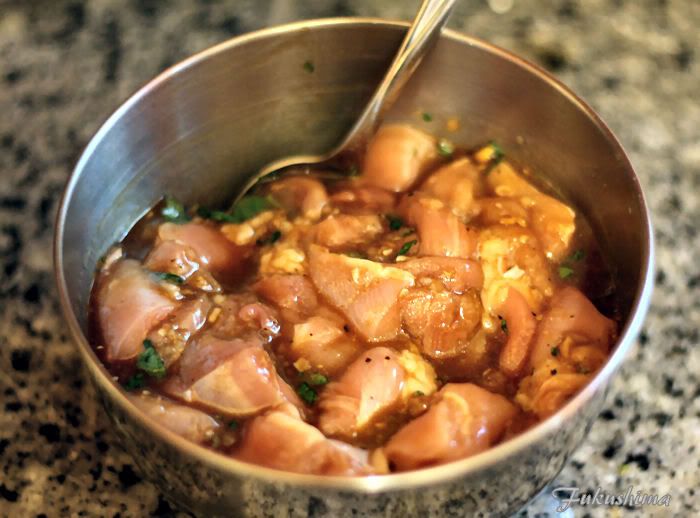
Marinaded, unlike the cook
From here, pieces of parchment were cut into 2" squares, 3" squares would have worked better, the notes in the book say that. Foo! Who reads books! Anyways, I like to place a leaf of cilantro in the middle of the parchment, then the chicken then fold.
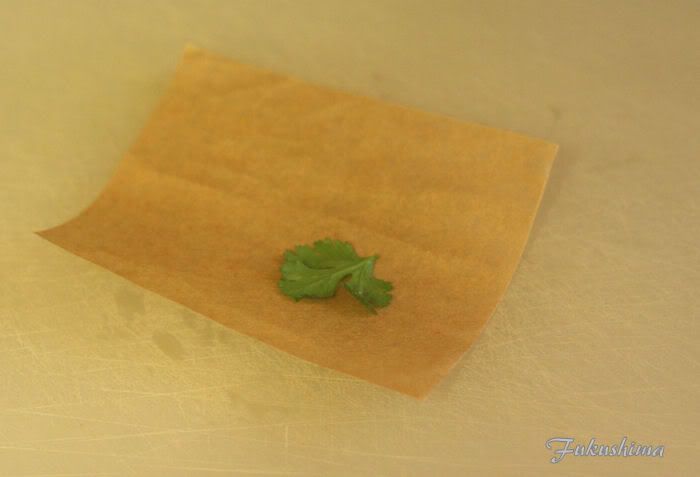
Cilantro Leaf

Chicken placed
Then folding the corner facing you up, fold the left corner in, then the right corner in, you should have something that looks like a parchment envelope, fold the top down and tuck it in. The idea is to get a nice tight sealed package. Foil is easier and looks like crap. Just my opinion. Fry in 3 to 4 inches of oil in a wok, you will want to fry in batched unless you have a large wok. I don't. Here is what you end up with.

See the nifty leaf?
The chicken is both fried and steamed, it has a unique character and due to the sealed in environment, it is also quite aromatic and intensely flavored once you open the packet. I love the texture of this method of cooking. Here is the cooks snack opened up.

Imagine these on a stainless serving dish

Chicken in Parchment!
From here, I decided I was done wrapping and decided to leverage the marinated chicken for a second dish. I took the marinaded chicken chunks, wiped them and coated with corn starch. I wanted to make a fine slurry, which was then tossed into the wok with several stems of cilantro to scent the oil. I fried in peanut oil, both for the flavor and smoke point. Here is the fried version, with a light crispy coating.
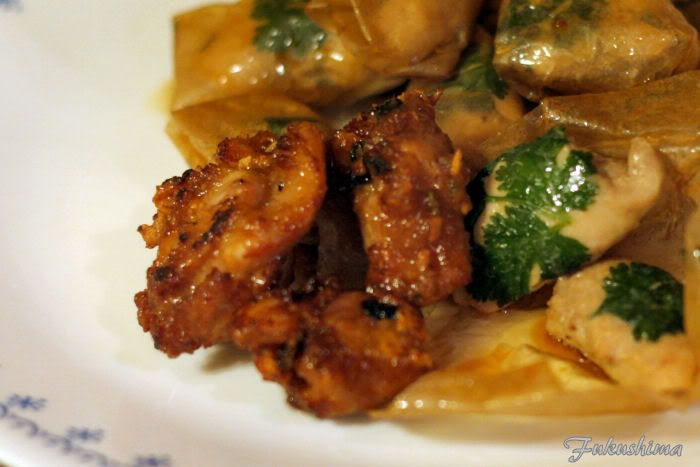
Fried!
You don't see Cantonese cooking much anymore, especially the stuff we grew up with, which was Americanized to fit the ingredients and tastes of the American market. I really enjoy this type of cooking, and the food, like all food, has that powerful effect of aroma and taste that transcends time. I love this marinade for wings as well, smoked or friend, stuffed of natural, this marinade really enhances chicken. Here is a plate of appetizers to finish off the blog.
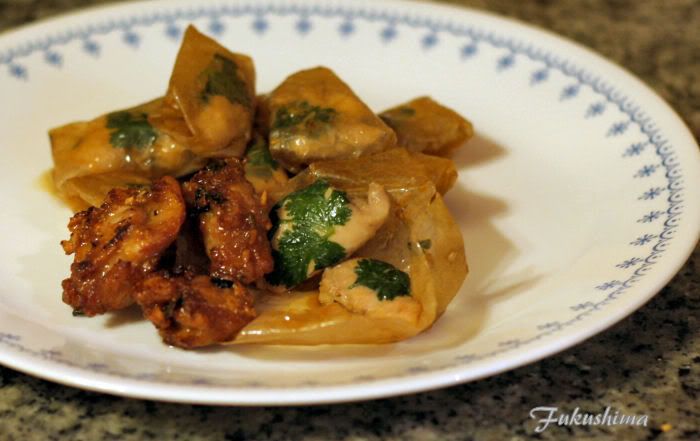
Who needs dinner?
Subscribe to:
Posts (Atom)